

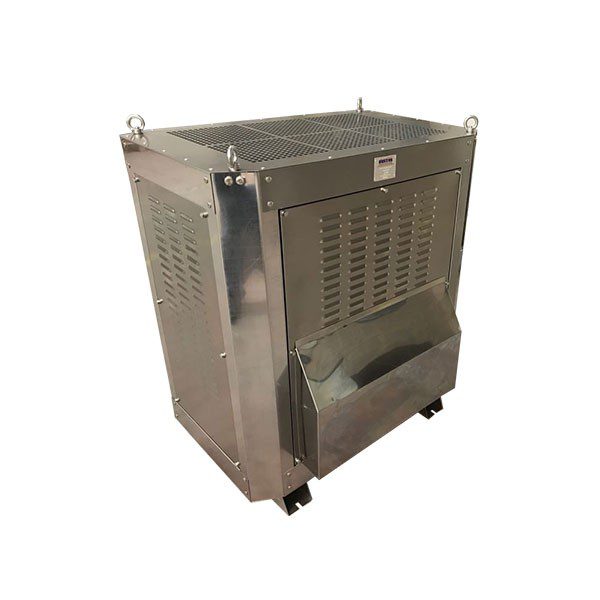
Under load, motors draw high currents (6-12 times) until reaching nominal speed, risking equipment damage. Starting resistors limit these currents, ensuring gradual acceleration. Aktif designs and supports starting resistors for existing systems.
Motor starting resistors can be classified in two groups;
Stator Resistors
Serial connected and staged resistors are connected to the motor entry (stator side) of squirrel-cage asynchronous motor and DC motors to reduce the input voltage and resistors are switched off in stages through contactors to decrease the motor input voltage and balance the torque speed.
Rotor Resistors
Serial connected and staged resistors are connected to the rotor of a slip ring wound rotor asynchronous motors to increase the motor impedance. Resistors are switched off in stages through contactors to decrease the rotor impedance in stages and balance the torque speed.
Advantages
- Easy access and maintenance to the resistor blocks on site thanks to blocks independently mounted to the frame
- Special mechanical and electrical design to withstand high temperature and extreme current values
Application Areas
- Steel Industry
- Mining
- Cement Plants and Other Heavy Industry
- Rolling, Conveyor, Lifting, Breaking, Mixing and Pumping Applications
Technical Specifications
- Stainless steel resistor material suitable for extreme conditions and resistant to oxidation (AISI304, AISI310, AISI316, AISI430, CrAl, CrNi)
- Spring wound, edge wound or grid resistor elements with a suitable cross-section
- Fully-modular, bended and stainless steel bolt connections in order to ensure electrical continuity at high temperature
- Standard IP23 protection level suitable for outdoor usage or IP20 suitable for indoor usage and perfect cooling , optional degree of protection from IP00 to IP55
Standards
- IEC 60060-1
- IEC 60071
- IEC 60273
- IEC 60137
- IEC 60529
| Type | Size | Download Link | |
| MSR - Motor Staring Resistors | 1 MB | Download |


