
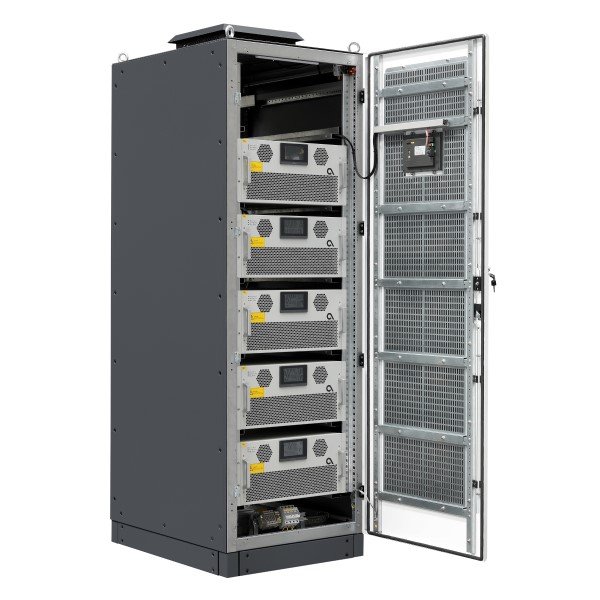

SVG series static var generators are used for inductive / capacitive reactive power compensation. SVG modules are designed for expansion and power increase with wall type single module or type tested SLV series modular panel structure.
Operation Type: Automatic / Manual / Fixed
Switching Type: High frequency IBGT
Connection Type: Pull-out design with plug-in bushing for fast serviceability
Harmonic Filtering: Up to 17th harmonic filtration
Advantages
- Instant response to fast and sudden load changes
- Capacitive and inductive bidirectional compensation
- Pull-out design with plug-in bushing
- Easy installation and power expansion thanks to modular construction
- Possibility of backup thanks to its modular structure
- Modular design for fast service
- 600 kVAr compensation in a 700 x 950 x 2100 mm panel
- Switching and compensation so as not to cause transient oscillations and harmonics
- Active and Reactive balanced or unbalanced load intervention for 3 phases independently of each other, 3 phase load balancing
- Possibility to use with generators as it does not cause voltage rise
- Low power loss
- Efficient energy consumption with Eco Mode Feature
- Less than 50 μs response time
Application Areas
- Buildings and Offices
- Bank Headquarters
- Steel Plants
- Cement Plants
- Mining Facilities
- Chemical Plants
- Textile Factories
- Petrochemical Facilities
- Ports and Crane Systems
Technical Specifications
- Voltage : 200 V- 800 V (±10%)
- Connection Type: 3 Phase 3/4 Wire
- Compensation Target: 1 ± 0.1 Cos phi
- Switching Frequency: 20 kHz
- Response Time: 50 μs
- Harmonic Filtering: 2nd ... 17th Harmonic Filtration
- Efficiency: ≥ 97
- Ambient Temperature: -10 ... +50 Cᶿ
- Protection Class: IP20 (Module), IP31 (Panel)
- Control: HMI display
- Topology: Three-level IGBT-based NPC
- Connection Type: 1 open/closed loop for module, open loop in parallel operation
- Reactive Power Capacity: Maximum 600 kVAr in a panel with 50 and 100 kVAr modules
| Technical Specifications | |
| Rated Voltage | 200 V - 800 V (±%10) |
| Rated Frequency | 50 Hz |
| Switching Frequency | 20 kHz |
| Bank Reactive Power (@ 400 V network voltage) | 500 kVAr |
| Line current rating per module (kVAr) | 50, 100 kVAr |
| Neutral current rating per module (kVAr) | Up to 3 times the line current rating |
| Connection Type | 3 Phase 3/4 Wire |
| Inverter technology | Three-level IGBT based NPC |
| Filtration Type | up to 17th harmonic |
| PFC Compensation Target | 1 ± 0,1 Cos phi |
| Redundancy | Any unit can become a master |
| Response Time | ≤ 10 ms |
| Efficiency | ≥ 97% |
| Application | Indoor |
| Protection Class | IP20 (Modul), IP31 (Panel) |
| Color | RAL 9003 / 7015 |
| Ambient Temperature | -10 ... +55 oC |
| CT Configuration / Operation Type | Open/Close cycle for one module, Open cycle in parallel operation |
| Humidity | Max. 95% non-condensing during operation Max. 85% non-condensing during storage |
| Cable Entry | Top entry for wall-mounted module Bottom entry for panel type module |
| Connection type for modules to panel | Plug-in Bushing |
| Maximum number of modules per panel | Up to 6 Modules |
| CT requirements | 3 CT‘s are required (class 1.0 or better, 15 VA) |
| Communication type | RS485 |
| Cooling | 1000 m3/h Air Flow with Metal Fan |
| Controller | 4.3 / 7 inches HMI |
| Dimensions (W x L x H ) | 700 x 930 x 2100 |
| Standart | EN IEC 61000-6-4:2019, EN IEC 61000-6-2:2019 |
| Wall Mounted SVG Units | ||
| SVG.50.400.1W | 50 kVAr, 400 V, 50 Hz Wall Mounted SVG Panel | 315 x 200 x 500 mm |
| SVG.100.400.1W | 100 kVAr, 400 V, 50 Hz Wall Mounted SVG Panel | 510 x 250 x 575 mm |
| Stand-alone SVG Units | ||
| SVG.200.400.2.1P | 200 kVAr, 400 V, 50 Hz Standing Alone SVG Panel | 700 x 1030 x 2100 mm |
| SVG.300.400.3.1P | 300 kVAr, 400 V, 50 Hz Standing Alone SVG Panel | 700 x 1030 x 2100 mm |
| SVG.400.400.4.1P | 400 kVAr, 400 V, 50 Hz Standing Alone SVG Panel | 700 x 1030 x 2100 mm |
| SVG.500.400.5.1P | 500 kVAr, 400 V, 50 Hz Standing Alone SVG Panel | 700 x 1030 x 2100 mm |
| SVG.600.400.6.1P | 600 kVAr, 400 V, 50 Hz Standing Alone SVG Panel | 700 x 1030 x 2100 mm |
| SVG.700.400.7.2P | 700 kVAr, 400 V, 50 Hz Standing Alone SVG Panel | 1400 x 1030 x 2100 mm |
| SVG.800.400.8.2P | 800 kVAr, 400 V, 50 Hz Standing Alone SVG Panel | 1400 x 1030 x 2100 mm |
| SVG.900.400.9.2P | 900 kVAr, 400 V, 50 Hz Standing Alone SVG Panel | 1400 x 1030 x 2100 mm |
| SVG.1000.400.10.2P | 1000 kVAr, 400 V, 50 Hz Standing Alone SVG Panel | 1400 x 1030 x 2100 mm |
| SVG.1100.400.11.2P | 1100 kVAr, 400 V, 50 Hz Standing Alone SVG Panel | 1400 x 1030 x 2100 mm |
| SVG.1200.400.12.2P | 1200 kVAr, 400 V, 50 Hz Standing Alone SVG Panel | 1400 x 1030 x 2100 mm |
| SVG.1300.400.13.3P | 1300 kVAr, 400 V, 50 Hz Standing Alone SVG Panel | 2100 x 1030 x 2100 mm |
| SVG.1400.400.14.3P | 1400 kVAr, 400 V, 50 Hz Standing Alone SVG Panel | 2100 x 1030 x 2100 mm |
| SVG.1500.400.15.3P | 1500 kVAr, 400 V, 50 Hz Standing Alone SVG Panel | 2100 x 1030 x 2100 mm |
| SVG Modules | ||
| SVG.50.400.1M | 50 kVAr, 400 V, 50 Hz SVG Module suitable for withdrawable design | 355 x 500 x 200 mm |
| SVG.100.400.1M | 50 kVAr, 400 V, 50 Hz SVG Module suitable for withdrawable design | 510 x 585 x 250 mm |
| Type | Size | Download Link | |
| PQ - Power Quality Solutions | 1 MB | Download | |
| AHF-SVG Electronic Based Power Quality Solutions | 1 MB | Download |
What is a Static Var Generator?
SVG is an electronic compensation system that dynamically meets the reactive power demand (inductive or capacitive) in the grid. Operating with IGBT technology, the SVG works at millisecond speeds and continuously, unlike traditional capacitor banks. It keeps the Cos φ value consistently close to 1.
What are the operating principles of an SVG?
- The grid voltage and load current are continuously monitored .
- If a deviation from the power factor target is detected, the system immediately generates the appropriate amount of reactive power.
- It provides inductive or capacitive power as needed.
- The three phases are controlled independently.
- Response time ≤ 10 ms
- It does not generate transient currents, making it safe and capable of operating in parallel with generators.
How does SVG work?
Continuously operating electronic control system:
- Detects reactive power imbalance in the grid
- If necessary, corrects the cos φ value by injecting the appropriate current via IGBTs
- Since it operates continuously, there are no “on/off” pulses as in conventional systems
- Since control is achieved through voltage, it is fast and quiet


