
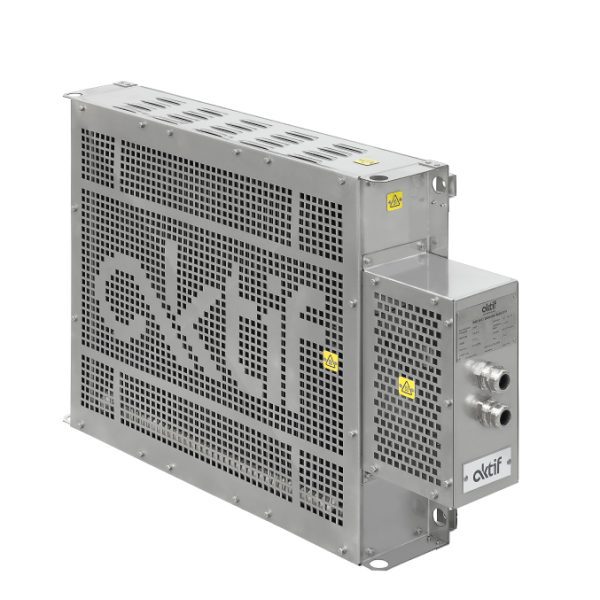

In railway transportation, power resistors are designed to meet challenging parameters and international standards. Their type, material, and structure are determined by factors such as installation location, cooling method, and pollution level, and they are tested either in factories or accredited laboratories.
Railway vehicles need a brake system to operate safely and to control the speed easily and quickly. The braking system is classified as mechanical braking, which converts kinetic energy into heat, and electrical braking, which converts power energy into heat. Railway vehicle motors work like generators during braking such generate regenerative energy and this energy damages the driver, other electrical equipments. Braking Resistor absorbs this regenerative energy and thus;
- It protects the drive by reducing the voltage of the power electronics system.
- It acts as an electric brake, controlling the speed of the vehicles.
Advantages
- Fast cooling
- Lighter in weight per kilowatt
- Low inductive characteristic
- Mechanical structure extremely resistant to vibrations,
- High flexibility for shock absorption.
Application Areas
- High-Speed Trains
- Locomotives
- Wagons
- Electrical Busses
Technical Specifications
- Operating Voltage: 25 kV
- Resistance Tolerance @20°C: -5/+7%
- Insulation: 70 kV for 1 min (Umax = 25 kV)
- Overvoltage Categories: OV1, OV2, OV3, OV4
- Pollution Degree: PD1, PD2, PD3, PD3A, PD4, PD4A, PD4B
- Protection Class: IP20
- Resistor Material: Stainless Steel
- Enclosure Material: Stainless Steel
- Cooling: Natural or Fan-assisted
Standards
- IEC 60322
- IEC 60077-1
- IEC 61373
- IEC 62497-1
- IEC 62497-2
- IEC 60529


